From Factory Floor to Sales Success: Managing complex sales cycles with CRM

Manufacturing sales teams operate in a high-stakes environment where every deal involves multiple stakeholders, lengthy negotiations, and fluctuating operational constraints. From supply chain challenges to pricing negotiations, even minor inefficiencies can accumulate, turning into significant lost time and revenue. According to Forrester, early estimates on generative AI’s impact suggests a 50% increase in productivity. This is transformative for manufacturing sales teams where every second counts.
Why manufacturing teams need a CRM
Relying solely on ERP systems to manage operations often falls short of what sales teams need. Implementing a sales-focused CRM, tailored for the manufacturing industry, can significantly enhance visibility, efficiency, and decision-making.
Customizable sales pipelines
Align sales processes with long buying cycles and customize CRM features to support your team’s unique needs and selling style. The right CRM allows for:
- Tracking multi-stage deals with multiple decision-makers.
- Custom workflows that adapt to complex negotiations.
- Visual pipelines to help sales teams anticipate bottlenecks.
Advanced reporting & forecasting
Visibility into deal progression is critical in manufacturing sales. AI-driven analytics boost sales forecasting accuracy by 42% through:
- Identifying stalled deals early and recommending next steps.
- Analyzing sales rep performance to optimize strategies.
- Automating reminders for crucial follow-ups and touchpoints.
Mobile CRM access
Field sales reps need real-time access to customer data while traveling between sites. Mobile CRM lets them:
- Pull up customer history before client meetings.
- Log calls, emails, and notes directly from their devices.
- Ensure fast collaboration with in-office teams.
AI-powered insights and forecasting
Sales leaders need real-time intelligence to make data-driven decisions. AI analytics enhance efficiency by quickly flagging high-risk deals that may require additional follow-up, highlighting top-performing reps to replicate best practices, and recommending next steps based on historical deal data.
Email and calendar integration
Manufacturing sales teams often rely heavily on email and calendar scheduling tools. Without CRM integration, manual data entry leads to missed follow ups. With CRM, sales teams can:
- Save emails directly to CRM records without switching platforms.
- Track customer conversations and interactions in one place.
- Sync appointments, tasks, and follow-ups effortlessly.
Personalized interactions
According to McKinsey, companies that grow faster drive 40% more of their revenue from personalization than their slower-growing counterparts. CRM supports personalization by:
- Leveraging AI-insights for more informed and tailored communication
- Providing prompts for outreach and suggesting optimal times to follow-up
- Keeping client data up to date and easily accessible with AI-insights and prompts
Collaboration tools for sales and operations alignment
Manufacturing sales don’t always operate in siloes; they must collaborate with engineering, product, logistics, distribution, and finance teams. A connected CRM allows for:
- Sales Operations Transparency: Ensure the sales team knows stock levels, delivery times, and production capabilities.
- Task Management for Complex Quotes: Automate workflows to assign responsibilities across departments.
- Better Team Collaboration: Keep sales, finance, and fulfillment teams aligned on client expectations.
Real-World Impact: How Sales Teams Benefit from CRM Adoption
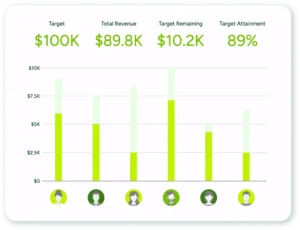
Sales leaders can increase a seller’s bandwidth by up to 27% per month by simplifying the sales process and utilizing AI-powered technology to enhance sales productivity. Sales leaders who integrate a manufacturing-specific CRM report closing deals faster, increasing seller productivity, and improving pipeline and quota attainment.
Looking for a CRM that balances power and simplicity?
Discover how Maximizer outperforms legacy CRMs with the tools your team actually needs.
Future-proofing your sales process
Navigating a complex manufacturing sales cycle doesn’t have to be overwhelming. The right CRM integrates into the processes and technologies you are already using, reducing implementation time and allowing you to feel the benefits rapidly. In many instances, the value of CRM with AI-powered tools can be felt in weeks, rather than months.
By adopting the right CRM, leveraging AI insights, and integrating with tools sellers use every day, like Microsoft 365, sales leaders can unlock new levels of efficiency and success.
Learn more about how Maximizer Sales Leader Edition provides visibility, efficiency, and measurable ROI by booking a demo with the team today.
Subscribe to our Newsletter
Related Articles