Forecasting the Future: How Leading Indicators Transform Sales Leadership

Today’s top sales leaders don’t just react to what happened last quarter – they anticipate what’s coming next. This foresight isn’t from extraordinary gut instinct – it’s from leading indicators.
Relying on lagging indicators – such as outcomes of past decisions and performance – is like driving while only looking in the rearview mirror. As Mike Curliss, President of Maximizer shares, what you’re doing now is going to drive your results sixty days from now. So how do you know your team is doing the right things today to create positive outcomes two months from now?
Leading indicators in sales
Unlike lagging indicators (like revenue or number of closed deals), leading indicators provide actionable insights into the future health of the pipeline.
Here’s what you should watch:
- Number of demos scheduled: Know early which reps are on track, and which may need more support.
- Outreach-to-follow-up ratios: Are your reps maintaining momentum, or do they lose steam after first contact?
- Number of new leads: Understand prospecting trends quickly.
- Time-to-contact for new leads: Is a new approach (like PVC) needed to improve connection?
- Engagement in prospect meetings: Are prospect meetings leading to further contact?
By tracking these metrics, you will have high-value leading indicators and data to intervene early, and course-correct before they impact results.
Levelling up with AI
The average sales rep wastes about 14 out of 51 hours a week on admin tasks. When working with leading indicators, AI flips the script by taking on a lot of the busy work.
AI tools automatically capture sales activities and can simulate increased targets, suggesting the exact number of additional activities needed to meet revenue goals. AI’s real-time insights surface critical patterns, like stalled opportunities or reps falling behind on outreach targets. Leverage AI and ensure data accuracy while reducing manual tracking and building capacity for your reps. If a deal is at risk because follow-ups have stalled, AI could suggest specific actions like sending an email or scheduling a demo, helping your reps be more proactive in their work.
CRM integration: your secret weapon
Where do AI-powered CRMs come into the conversation? Mike suggests thinking of CRM as the “nerve system of an organization,” and integrating your selling playbook with CRM to clarify your targets and align your teams.
Training your CRM to track leading indicators means that every rep has access to the same step-by-step process, plus built-in AI support to ensure everyone’s on track and offer value-added suggestions when needed. If someone new is joining your team, every step of your sales process is embedded into your CRM so new hires can immediately align their processes and goals with the rest of the team’s sales trajectory.
With CRM keeping track, your teams start moving leads from stage to stage with consistency and confidence.
Leading indicators as a leadership tool
It’s not just sellers who benefit from tracking leading indicators. As a sales leader, use leading indicators to make decisions proactively instead of reactively. Identify bottlenecks early and make informed decisions on how to redistribute resources to high-potential deals. Know early who your top performers are, and which sales reps need more support. You can even gamify metrics like outreach volume and response time, transforming leading indicators into a tool for team motivation.
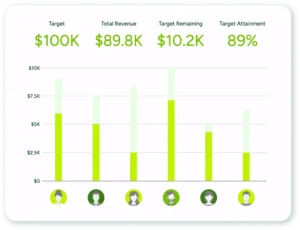
Use CRM to track activities and provide real-time dashboards. CRMs like Maximizer are desktop, laptop, tablet, and mobile-friendly – so no matter where you’re working from, you can access daily reports summarizing tasks, follow-ups, and team performance. Maximizer offers real-time coaching during calls, suggesting conversation points based on industry and deal stage.
Establish baselines and incremental goals for each metric and use CRM to keep surpassing them.
Getting started on your CRM journey?
Unlock your sales potential with a free Maximizer demo. Discover how to optimize lead management and build a powerful sales pipeline for your team.
Shape your future with confidence
Sales leaders tracking leading indicators can expect more predictable and consistent pipeline health, better alignment between sales activities and revenue goals, and reduced time spent on reactive management – clearing more time for strategic planning.
If leading indicators create a tangible rubric for the health of your sales pipeline, AI-driven CRMs tell you how you’re scoring at any given moment. Beyond organizing data, CRM supports and keeps your team on track, offering suggestions, flagging problems early, and giving you the tools you need to not only forecast the future, but shape it your way.
Want to hear more from sales leaders who understand the power of leading indicators? Watch Mike Curliss (Maximizer President) and Mario Martinez Jr (CEO of FlyMSG) discuss their experience and expertise in Maximizing Sales Success: Leveraging the best tools for sales leaders.
Subscribe to our Newsletter
Related Articles